maandag 13 juli 2009

First 'sail'

This sunday I finished the rig (only have to alter the cars on the main and work out the tiller to get the boat ready) and could manage a 8 minutes trip with the jib + motor up and down the marina before we ran out of time and had to pull the boat out of the water to get home in time.

Next weekend me and my brother will go for a one-week sail to test the boat, finish all kinds of loose ends, and hopefully learn to sail it. On tuesday of that week Luis Matos, another F22 builder, will join us (all the way from Portugal!) for one day to get a feel for the boat in real life.

Last sunday I had no time for pictures, but for those who are interested anyway here is some text-only about things I noticed:
  • With the aft cockpit-boomless-version of the F22 the tiller has not much travel left-right before it hits the point where the traveler sits on the cockpit seat. It's probably a good idea to put some extra blocks under the traveler to lift it a bit and make some more room for the tiller. It will only help a bit though. I will alter it this this winter.
  • Because the tiller is fixed and can't swiffel up you can't stand up holding the tiller when sailing/motoring, and don't have a clear sight. I'm going to attach a joystick to the tiller: problem solved.
  • It is possible to hang a small-ish outboard (mine is a 4 HP two stroke Mecury long shaft) on a bracket next to the rudder: the prop can't touch the rudder in any position and there is enough clearance to tilt the outboard completely out of the water.
  • On low speeds the rudder doesn't seem to 'bite' very well. I guess this is normal for this type of rudder, I'm just not used to it as I've only had boats with relatively large rudders that worked well at very low speeds.
  • Manoeuvring with a (very) low speed, as will be necessary in the sometimes very crowded and small locks and harbours/marina's in the Netherlands, will probably only be doable by steering with the motor. In this respect I'm glad I built the aft cockpit version.
  • Because the boat is so light and wide, it drifts quite a lot with only mast up when there's some crosswind. Going to have to practice a lot to learn to manoeuvre this boat under power in tight areas.
  • The overall strength of the sandwich hulls is great, they're stiff and light, but I'm not really happy with the impact resistance (concentrated load). Sunday my second bulge (very small one) in the boat was caused by a brief encounter with the corner of a jetty. First small bulge was caused by a corner of the plastic wheel arch of the trailer which pressed against the float when the boat was rocking a tiny bit on the trailer while driving. Since then I've lowered the wheel arches. Guess there will be a lot more scratches and bulges to come.
  • The shrouds stay tight folded, unfolded and while folding. Nice!
  • Raising the mast is easy when you use all the raising wires to support it and also use the 'ears' on the maststep. The pops on the ball (raising) or pivot-pin (lowering) with ease.
  • Centerboard lowering needs a bit of muscle: didn't expect the board to be that bouyant.
  • 2:1 jib sheet seems to work fine.
  • Sailing with jib alone to the wind is possible (a bit), but you have to helm a lot (duh).

zondag 28 juni 2009

Working on rig.

My brother Hans has gotten really enthousiastic about working with the dyneema ropes and is making all kinds of handy parts for my rig, like soft hanks and, below, a tackle for my back up forestay (nylon washers make sure the lashing-rope doesn't bind).
Below picture for my wife Jacomien: yes, I fitted the wind-pointer (???). She demanded I'd fit one (she still has good memories of two boats I owned earlier on - a nordic folkboat and a waarschip 7.25 - which had the same pointer). Telling it's not necessary to have one were to no avail: she gave me the pointer for my birthday and how can I refuse this present?
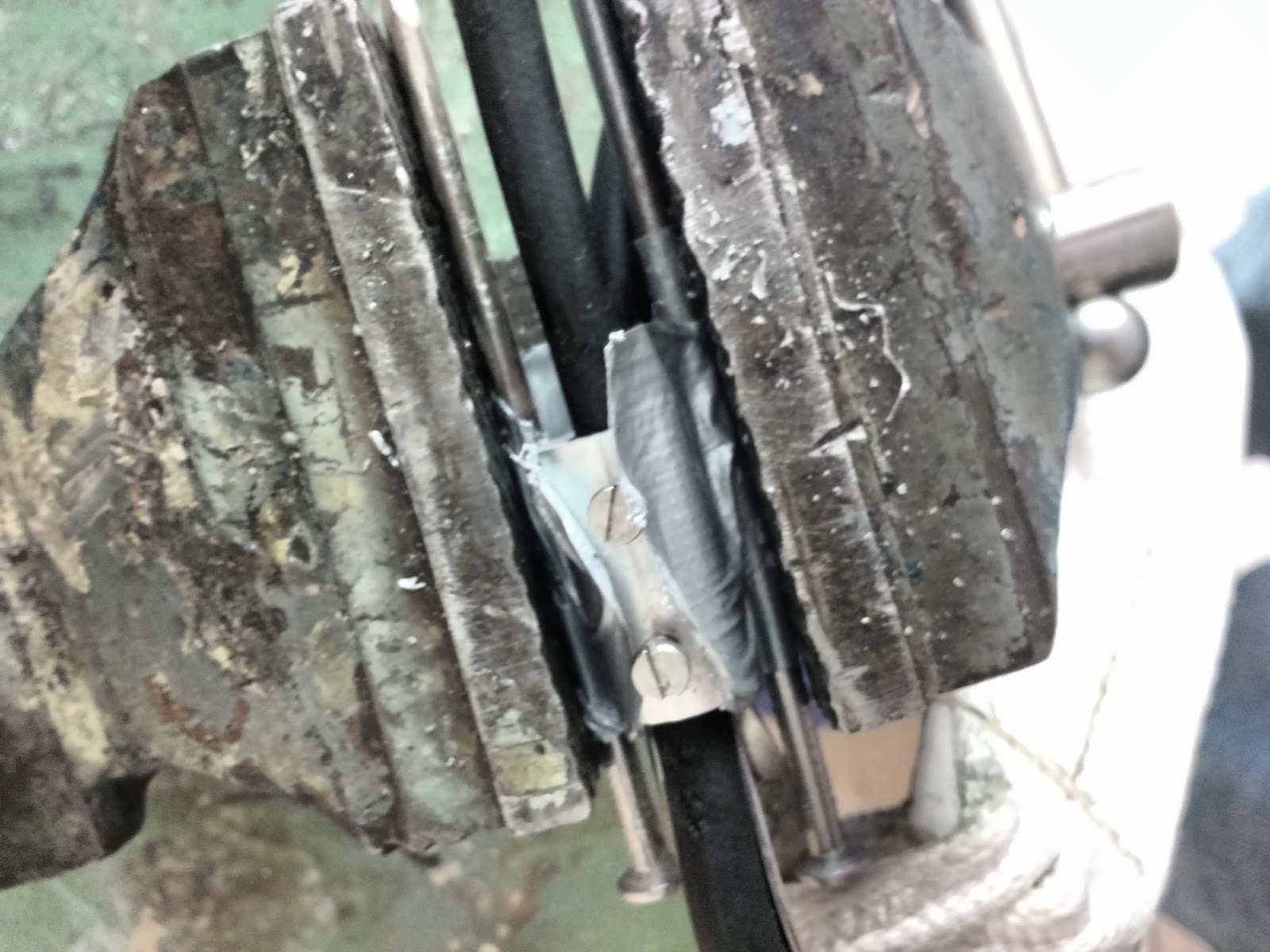
For ease of mind I made a backup fitting for the shrouds with a piece of 6 mm dyneema and some vulcanising tape (later on a picture which will be more clear). The knot is the same knot used for the soft hanks (don't know the name), and is made by Hans.
Finished.
My plan was to attach the shrouds with 8 mm olivier links produced by Precourt. However, I got fed up waiting for a response from Precourt about the links he is supposed to be working on, and decided to use two pieces of hardware that were delivered with my mast-section. They are actually meant to anchor ball-terminals, but I figured they might as well anchor a dyneema loop.
Below the overview of the setup: 6 mm dyneema soft hank (the line is fed through itself and then finished with a big 'turkish' knot). The end-knot is not finished smooth: instead the two ends are left proud and there's an extra knot in both lines to make sure the knot won't slip and open up. I made a hdpe bush on the lathe to make sure the loop doesn't chave.
Below an overview of the attachment of the shrouds: 8 mm shrouds (SK75) anchored on the ball-terminal-loops, and secured to oneanother and to the extra mounting point with a piece of 8 mm SK75. The mast will only come down when all three mountings fail, which I don't expect to happen. I will be cruising only, and this setup seems plenty strong for that purpose.
I will for the time being keep my rig very simple. Main halyard with a stopper on the mast (not running to the cockpit) + a tackle at the mastfoot to tension the luff of the main + backup forestay + furling jib with a fixed swiffel (jib will be hoisted with a dyneema line 2:1) + 2:1 sheeting of the jib with no winches. Unfortunately the swiffel & furling drum take up a bit too much space: the jib would hardly fit in between and would not furl properly as the backup forestay was in the way. I need to make a separat tab a bit higher to mount the forestay.
Below a detail of mast raising setup: the trailer winch-band which I use to raise the mast is kept central with a dyneema loop round the bullnose. Here you can also see the stainless steel furling drum which I could buy second hand for not too much money. It's difficult to get anything attached in the hole in the deck with the bow web below and I don't think this setup will work properly (just too small). If I remember right Ian Farrier wrote this is still a loose end in the design.
A part of the design I didn't follow (yet?) is the mast raising wires-supports bolted to the side of the cabin. Instead I made a wire between my lifting eyes with shackles at the ends, and with an eye at the height of the pivot pin. This works well, just onhook the wire and you're done. Loads will be a bit higher because the wires are not at the edge of the cabin, but I don't think loads will be too high.
Overview of the setup (sorry, forgot to turn the picture).
And this is how it looks the right way up....
Below: mast raised 30 cm and feeling steady. Before rigging all the support wires we tried to raise the mast with just the raising pole, but quickly quit. Although this mast is quite light (30 kg or so) it's not easy to handle. Raising it with just some muscle and faith is not for me.....
And.... the mast is up. The rake is of course way too much in this picture. We kept the shrouds short to make sure we wouldn't tip the mast over when raising. You can see the support wires for the mast raising pole are slack, that's my mistake: I used the maststep ball as a reference point for the mounting point of the support wires instead of the pivot pin.
Finishing the boat and all the hardware has taken a lot of time, and I'm still not there. Need to lower the mast again, make a new tab for the backup forestay, grind a slot in the mast for the cars of the main, fit the outboard (will be tight), make a tiller, try to lower the furling drum 2 cm to get a bit more clearance at the top of the jib, etc. etc.
Still the plan is to launch in about three weeks. I'll sail the boat for a week with my brother, and use that week to tune the boat and see if everything works the way it should.

dinsdag 23 juni 2009

In the water

This weekend me and my brother laced the trampolines and put the boat in the water to test it. We were in a hurry, so I didn't take my time to get nice pictures. Still here are some....

Photo below: the lifting eyes work well. I need to make the front two hoisting slings a bit longer to lift the boat horizontally.

First time in the water. The centerboard pivot doesn't leak (didn't think it would, but you never know). The boat is floating very high. Hope this is how it's supposed to be.
My brother is lashing the trampolines.
Close up of the trampolines below: lashed with 2,5 mm dyneema SK75 (cheaper than a roll of nylon, but hard to get tight as it is difficult to pull). I still need to work on the attachment of the beginning + end of the lashing to the hull. Details will follow in due time.
The trampoline is a bit too close to the hullside to my liking, and it is difficult to get the lashing tight like this. I'll have to live with it for at least this sailing season, maybe I'll alter the trampolines this winter. Tip for future builders: maybe make the trampoline a few cm less wide than plans specify, or first finish the hull + floats before making the trampolines, so you can measure the actual distance between the float-rail and the hullside.

Below the front view. I guess the boat will be a bit lower in the water once I put the mast on the boat and put some extra gear in it. That would be a good thing, because the floats are now a bit too high above water.

donderdag 18 juni 2009

Trampolines

I stitched my trampolines on this old Singer sewing machine (it is motorized). It can't zigzag, but for the rest it works just fine. The trampoline was put together with double sided tape before stitching. Lesson learned: stitch directly after using the tape. One trampoline was put away for a while unstitched and more or less fell apart. What a sticky mess! Other tip: spraying a bit of WD40 on the needle helps to make sure the needle +thread don't stick too much to the tape.
For the lacings to the hull I won't use rings, but a 6 mm alu rod in the sleeve. Probably stronger than rings, and less fuss.
The shop I bought the materials warned me the last ring on the side of the trampoline is loaded a lot and has a tendency to fail. That's why I strenghtened it a bit.
Apart from the tiller and some small jobs the boat is ready. I still have to take care of the rig and the raising pole + wires, though. I can't finish that because I'm still waiting for Erik Precourt to fabricate the 8mm version of his Olivier Link which I plan to use for the shrouds. Erik mailed me he would be working on the links this week, so I hope there will be some white smoke at the end of the week.


maandag 15 juni 2009

Plastic Fantastic

Working on some of the last parts of the boat: bushings.
Some time ago I bought a very old Unimat SL micro lathe, it works OK for plastics and small metal work.

Below: piece of Arnite (PETP) rod in lathe.
Step 2: outside diameter ready.
Step 3: inner hole bored. I tried to do this on the lathe first, but this didn't work (too slow: in stead of cutting I melted the bushing-to-be). In the drill press it was a piece of cacke. The two pieces of hardwood with triangle-formed cutouts keep the rod level (vertical). This works well, as long as you make sure the cutouts in the woodblocks are cut precise (no problem for me, because I'm a happy owner of a very precise festool table saw).
Below: finished bushing for the rudder. No, it's not as good looking as a professional bushing. Yes, it will work anyway. No, it's not worth to save money this way (unless you've got time to spare) but I just enjoy trying to fabricate parts myself.
Below: bushing for mast pivot ball, made out of Delrin rod. The router bit was very expensive for the (this) one time I will use it.
I've got plenty of delrin to spare, and my expensive router bit. If someone is interested: I can send some delrin rod with the hole routed in it for the costs + a few dollar for my invested time, and save you the trouble of buying the router bit. I also have a spare type 316 1" ball I can send with it.
Plans call for acetal washers for the folding system. I couldn't find ready made washers, so just drilled a hole in a piece of delrin rod and chopped washers off on the bandsaw.
This weekend I drove the boat to my home to pick up the mast (the mast was hanging in my garden) and tried to shoot some photo's back at the marina but instead by accident made a film. Still some people might be interested, so below is the clip.

video

donderdag 4 juni 2009

Mast Step + Retaining Thingies

Still got to make some pieces. Below is the mold + glass for the four beam retaining brackets. I made the mold on the bandsaw (my advice: buy one if you haven't got one!) of some scrap pieces of mdf.
When cured I cut the mold + glass in four straight pieces on the table saw. I know it's not good for the sawblade, but for this kind of work I use a blade that's already damaged (hit some screws with it long time ago).
Below the finished brackets and the (almost) finished mast step.
Welding aluminium and making it good looking isn't easy. The mast step looks messy (+ I burned a hole in the top side of the tube) and sure won't be in the book 'This is pro welding". I'm not dissatiefied though; part of the fun of building for me is trying to acquire new skills and experience (like welding). Having a not so good looking mast step is the price I have to pay for that choise.
Although the mast step is not good looking (looking from close range), I'm sure it's strong enough.
I have to do one more weld in the low corner and cut off + isolate the bolts and then have to decide on the finish. Camouflage paint might be the best option.
I'll probably just prime it with epoxy primer and then paint it. The mast foot in the mast will also have to be treated, as well as the mast support and the (still to weld) mast raising pole.
I would actually rather leave all those pieces untreated, as painting will probably look messy and anodizing is a lot of trouble and not always possible (can't anodize the mast foot as it is welded in the mast). What will happen if I leave all the pieces as they are? My boat will mostly be sailed on fresh water. Anyone with good advice?


dinsdag 26 mei 2009

Fitting folding system + floats

This will be a bit long and maybe boring post, but I thought some of the other builders would be interested in as much details as possible about my experiences fitting the beams.

Saturday and sunday me and my brother Hans worked hard to get the folding system and the floats installed. Saturday we worked on the folding parts on the mainhull which was on its trailer in the marina. Saturday evening we pulled the trailer with the mainhull to my workshop. The square in front of my workshop is used for parking cars from monday till saturday, but on sunday it's usually not occupied. So I had one sunday to install everything and move the boat again.

On sunday we started working at 8 in the morning, and worked almost non-stop till 9 in the evening. By then the boat was assembled enough to be able to bring it back to the marina (about 1 hour drive). My idea to pick up the mast on the way back was too optimistic. I'll have to drive back another time to pick it up.

First thing we did was fitting the bushes in the beam mounts. This can be easily done by sticking the bush with some double sided tape on a sawblade and use that to insert the bush in the mount.
Then we leveled the trailer (used a tube with water to level; when you do this make sure there are no air bubbles in the tube). With the trailer leveled we attached the upper folding struts to the hull and then to the beams.
This took more time than expected, because on one beam mount the holes for the bushings were not in line (see last part of the linked entry). The pivot pin would not properly go through both bushes because of this misalignment, and we had to use a lot of force. Destroyed one bushing in the process, but luckily I had a some spare bushings.
The fit of the beams in the aft beam recesses was not perfect. I had to grind one beam end back a bit to make it fit in the recess (but not as much as the line drawn on the photo below).
Because I knew I didn't have much time to install the beams I made two dummy decks of the floats (below - box sections of fir battens with cheapo 3 mm multiplex) so I didn't have to worry about the distance between the beam ends nor the twist of the beams.
I don't know if it would have been difficult without the dummy decks, but with the dummy decks aligning the beams was a piece of cake. First we put the end of the dummy decks on two ladders and put blocks and shims underneath until the beams were level. Then we clamped some battens along the edge of the dummy decks and used a rectangualar piece of mdf to check if the angle between the beams and the dummy deck was 90 degrees (see photo below).
With the level and the piece of mdf it was easy to quickly recheck the alignment now and then during the installation. I was a bit worried the fore-aft alignment of the beams would give problems as I had noticed that at least one beam mount was a bit out of angle fore/aft (it was pointing slightly to the front), and apart from that for some reason I managed to get the location pins of both floats about 8 mm too far apart. But much to my surprise the vertical alignment of the beams seemed near perfect. Maybe by miracle I also installed the beam mounts 8 mm too far apart, but more probably it's just hard to notice the few mm misalignment.

On all four beams it seems the beams are sticking out a bit too far at the beam mount, and I will have to grind the end of the beams (maybe even considerably on some beams) to make space to fit the beam end plate. Thought this part of the alignment would give the least problems and the fit would be the most accurate, but clearly it is not so. Don't know why.

The brackets all fit on the bolting area perfectly. Big relief again.

After aligning and bolting the beams+folding structure we had to hoist the floats down. This time not with a crane, but with some lines and chain hoists.
Yes I know, this is not a very smart way to hoist a float. Still the floats came down with not too many scratches.Bolting on the floats was not difficult either. We folded out the beams, put two workmates underneath the beam ends, lifted the float on the workmates and while one person held the float steady at the bow, the other put some blocks under the keel till the beam bolts stuck in the float deck at one beam. Quickly put a nut a few turns on one beam bolt and it's temporarily fixed. Then fix the float at the other beam the same way. It's not necessary the float stays level: it's possible to put the beam bolts on one side in the float deck with the float hanging, say, 20 to 30 cm below the other beam end.

After fastening four of the six bolts per beam the boat was solid enough to fold in and drive it back to the marina. I still have to glue all the brackets and beams and to fix the beam end plates.
The folding works very well, it's something you've got to see/feel for yourself to believe.
Below the boat is ready for the ride back.

Detail below: I replaced the stainless steel trailer eye by a loop of 6 mm dyneema with a knot on the inside. Easy and it seems to work well.

I never realized how wide the folded boat was at the bow end, but now I do.

Last photo: getting the trailer out was only just possible.

To conclude some lessons learned/things I noticed:

  • It's not necessary to level the boat lenghtwise to install the beams. It's sufficient to make sure the left and right beam mounts are level. When the boat is on a trailer (make sure it's tied down firmly on the trailer) this is easy: put fixed blocks under the front end of the trailer and one of the two aft corners, and jack the other aft end of the trailer until the aft beam mounts are level. Front beam mount should now also be level.
  • Bolting the aft beam compression formers with the four bolts is terrible. There is by no way enough space inside/underneath to get all nuts on with washers. I even had to redrill two bolt-holes at a *very* slight angle to be able to get a nut on. Maybe it can work out right on a computer screen, but I doubt ever in the real world.
  • Important for european builders: I thought the bolt blocks hanging inside the beam mounts would be tapped M12, but (should have known this probably) they were tapped with a non-metric thread. I had no possibility to get the right bolts on sunday, and had to turn in my M12 bolts in anyway. I probably damaged the thread too much and I will have to replace those blocks.
  • When making /installing the aft beam recess mold plates, rather err on the 'big side' because this area is tight when done properly and too tight when you make the recesses by mistake a little bit smaller than per plans.
  • It's easiest to line up the metal hardware on the aft beam mounts by first only putting in the outer bolts left and right, and then use a wire or a long straight piece of wood/metal to put the hardware on both ends exactly in line with eachother. This way you can correct any possible misalignment of the beam mounts (in case they are angled a bit forward or aft).
  • The holes on my beam brackets were all a bit less than 10 mm diameter and I had to redrill all the holes. Better check & fix this before putting the folding struts on the beams.
  • Fix your main hatch while driving. Maybe it's enough to firmly fix the front legs of the hatch. I thought the driving wind would always be pushing the hatch down, but while driving the wind got underneath and the front popped up. The hatch then acted as a big 'wind trap'. Good thing is now my whole boat has had an excellent ventialation.